

What features are unnecessary for your mobile app?
Table of contents
 28-05-26Read Time: 13 min
Customers of mobile products often try to include a maximum of functionality in the project. At first glance, it seems that the more functions, the more modern and expensive the product looks. But in practice, it is overload that often causes increased development times, budget overruns, and low user engagement. Most successful mobile applications start with simple solutions that cover a list of specific tasks.
The concept of “extra functionality” is always relative. Therefore, before launching a mobile application, it is important to correctly determine what the business really needs and what functionality will help achieve the set goals. What will be completely unnecessary for one mobile application may be critically important for another. Therefore, each project should be evaluated separately, taking into account the business model, audience, usage scenarios, and product specifics.
Why might some features be redundant in a mobile app?
Not every feature that looks interesting at the project discussion stage actually brings benefits after launch. In some cases, individual features may complicate interaction with the application, require significant resources for implementation, or simply do not meet the real needs of the audience. That is why, when forming the functionality, it is important to prioritize each solution and assess how much it affects the ergonomics of the interface, business indicators, and the future development of the product as a whole.
Redundant functionality
One common problem is trying to add as many features to a mobile app as possible at the start of the project. This is often due to the desire to keep up with competitors or create a universal product for all occasions. The application is overloaded with complex scripts, additional interface elements and functions that are used by a small part of the audience. Excess functionality complicates navigation, increases development time and can negatively affect the speed of the application. This is critical for the minimum viable version of the MVP, when the main task is to quickly launch and test the main idea.
Mismatch with business objectives
Any function in a mobile application should solve a specific business problem: sales, process automation, payment processing, order processing, customer service improvement, user retention, conversion increase, feedback, etc. If the functionality has no practical value for the business, its implementation is impractical. The customer incurs additional costs, but does not benefit from the product’s efficiency.
Low user demand
A feature that seems useful to the customer does not necessarily become in demand by users after launch. Additional integrations, complex settings, non-standard interaction mechanics – all this must be needed by the audience, otherwise it is just a wasted budget. Mobile application users usually expect quick and easy execution of the target action. If the functionality does not help solve the main task or complicates the use of the service, it may remain unclaimed. That is why, before implementing complex solutions, it is important to analyze the behavior of the target audience and test hypotheses in practice.
High cost of support and updates
Each additional feature requires not only development, but also support after the application is launched. This applies to updates, bug fixes, adaptation to new versions of iOS and Android, integrations with third-party services, security requirements. The more complex the functionality, the more resources are required for the stable operation of the product. In some cases, the costs of supporting individual features may exceed their real benefit to the business. Therefore, when planning a mobile application, it is important to consider not only the cost of development, but also the long-term costs of product support.
What features not all mobile apps need
Complex registration functionality
One of the most common mistakes is overloaded authorization and registration. Entering an e-mail, phone number, SMS confirmation, creating a password, filling out a questionnaire and additional verification steps often significantly complicate the user’s first contact with the service. In many cases, a quick login via a Google account, Apple ID or phone number is enough. The easier it is for a user to start interacting with the application, the lower the risk of losing the audience at the registration stage. A complex authorization system may indeed be necessary for banking services, corporate platforms and other applications with increased security requirements. But for most commercial mobile products, unnecessary steps at the beginning only reduce conversion.
Built-in chat “just in case”
Many customers want to add an internal chat just because such a function is available in popular services. However, in practice, most users continue to communicate via Telegram, Viber and other familiar messengers. Developing your own chat is a separate module that requires time and resources for development. A built-in chat is really needed for marketplaces, delivery services, CRM systems or platforms with constant interaction between users and managers. But if active communication between users is not the basis of the product, such a function may be unjustified – you can find out about it only after a deep analysis of the audience’s needs.
Push notifications without a strategy
Instant push notifications can be a useful tool for audience retention, but only if used correctly. If a user constantly receives unnecessary messages, it quickly becomes annoying and leads to disabling notifications or even deleting the application. Push notifications should bring real benefits and be used as part of a loyalty program – informing about order status, important changes, personal offers and other events that really concern the user. Messages without clear logic often have the opposite effect.
Complex animation and “wow effects”
Complex animations, non-standard transitions, and a large number of visual effects may look impressive in a project presentation, but they do not always improve the real user experience. Excessive animations increase the load on the device, worsen the speed of the application, and can distract the user from the main actions. In most cases, a simple, clear, and fast interface works much more effectively than an overloaded animated design.
Offline mode without critical need
Offline support is one of the difficult features in mobile development. It requires local data storage, server synchronization, and additional information processing logic. Offline functionality is really important for navigation services, travel applications, or working in remote regions. But for most mobile applications, this feature is not critically necessary, since users have constant access to the Internet.
AI functions for the sake of trend
The popularity of artificial intelligence is leading many companies to try to add AI functionality without a clear understanding of its practical benefits. The phrase “add AI” is not a business objective in itself. AI can be really useful for automating support, recommendations, data analysis, content generation, and processing large amounts of information. But if AI does not improve user experience, does not provide business benefits, and does not optimize processes, it turns into just an expensive but meaningless marketing ploy.
Integrations with a large number of third-party services
At the start of a project, companies often want to integrate CRM, payment systems, analytics, mailing services, maps and other platforms at the same time. A large number of integrations significantly complicates development and increases the risk of technical problems. In practice, for the first version of the application, only key integrations that directly affect the business and shape the user experience are usually enough.
Advanced analytics without real need
A detailed reporting system and complex analytical panels may look useful, but often a significant part of this data is not used by the company in its daily work. For most mobile applications, basic analytics are enough at the start: the number of users, conversion, audience activity, targeted actions within the product. Complex analytical tools make sense only when the company really works with large data sets and makes decisions based on them for business development.
How to identify unnecessary app features

At different stages of mobile development and after product launch, unnecessary functionality can be identified in several ways:
- A/B testing.Allows you to compare different versions of the functionality in action and determine which one works more effectively. During A/B testing, some users see one version of the functionality, and others see an alternative. After that, the conversion, activity, and behavior indicators of the two audience groups are analyzed. The decision is made based on real data, not assumptions.
- Analysis of real user behavior.Analytics systems allow you to determine which screens and functions are used more often, and which remain invisible to the audience. You can track the number of uses of a specific function, the popularity of individual sections, the time of interaction with screens, application exit points, and user scenarios.
- Analysis of business indicators.It is important to evaluate functionality from the perspective of business results. Each function should directly or indirectly affect important indicators – sales, applications, conversion, customer retention, process automation, etc.
- Feedback from users.Audience feedback in the App Store / Google Play and support requests help identify problems that were impossible to predict in advance and difficult to detect through analytics. Usually users directly point out features that complicate interaction with the service or have no practical value for them. You just need to listen and take the information into account.
- MVP and incremental scaling.Launching a “minimum viable product” allows us to test core features with minimal costs. After launch, we get real-world data on audience behavior and can gradually add new functionality to make more efficient use of the project budget.
How ill-conceived functionality harms an application
In mobile development, it is important to focus not on the number of features, but on their practical benefit for the business and the user. Unjustified functionality often complicates development, worsens the user experience and creates additional costs for the business. This is especially true for the first versions of the product, when the main task is to quickly launch, test the idea and get feedback from the audience.
- Increasing development costs.One of the main problems is the increase in cost and development time. Each additional function is a separate stage of design, programming, testing and further support. Integrations with third-party services, complex personal accounts, analytics systems or AI modules can significantly increase the project budget even before launch.
- Deterioration of user experience.When an app contains too many features, it is harder for the user to quickly understand the logic of the service and perform the intended action. As a result, conversion decreases, the number of unfinished scenarios increases, and audience retention worsens.
- More technical problems.Unnecessary features increase the load on the system, make updates more difficult, and increase the risk of bugs. The more complex the product, the more resources are required to support it, optimize it, and ensure stable operation on different devices.
- Low business efficiency.Often, companies invest heavily in features that are used by only a small percentage of the audience or by almost no one. In such cases, the additional functionality does not bring real value, but significantly affects the cost of developing and further supporting the mobile application.
How to understand what features your app needs
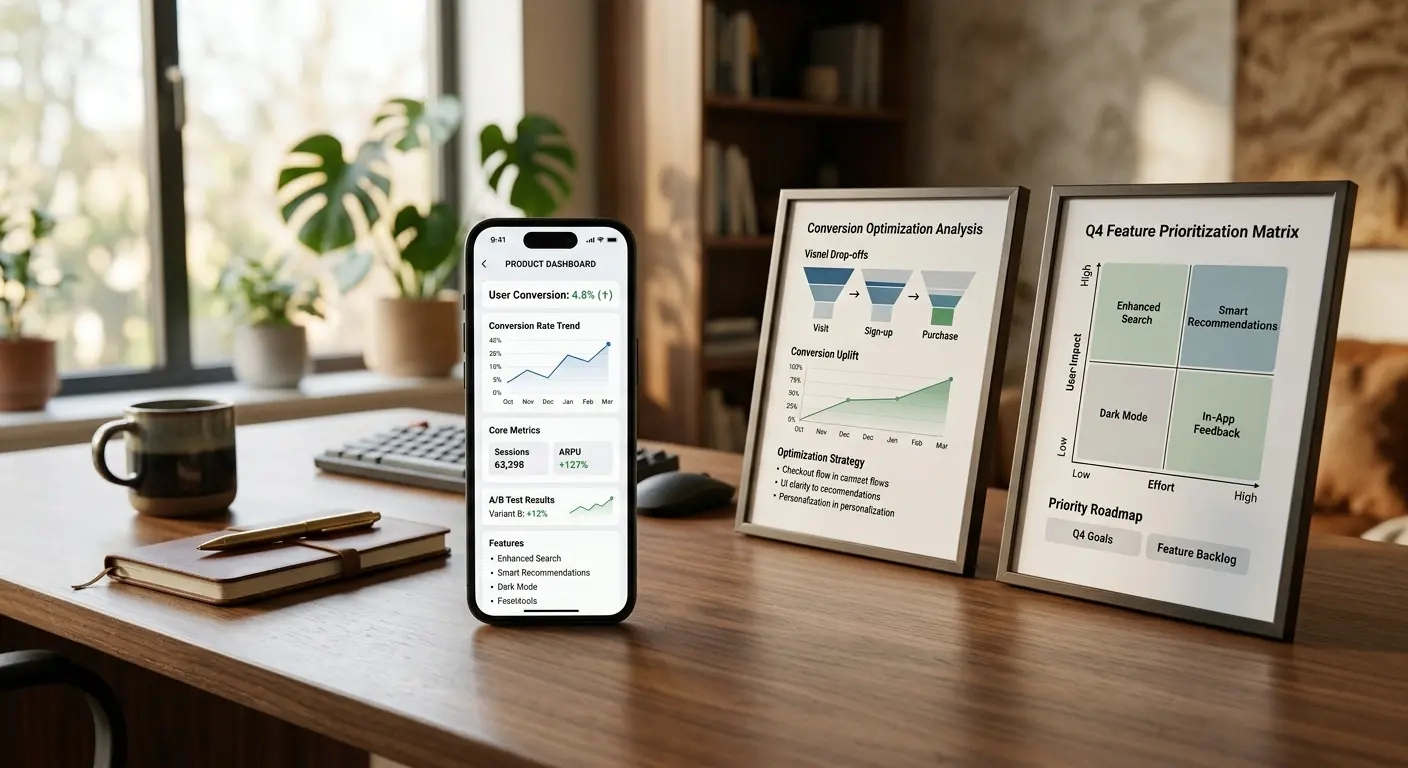
At the stage of developing a mobile product strategy, it is important to evaluate the functionality in terms of its practical benefit for the business and users. Even a technically complex or trendy feature may be unnecessary if it does not affect the main tasks of the product. Therefore, before forming the functionality, it is important to:
- analyze the niche, product and business;
- study the target audience, its needs and objectives;
- assess the strengths and weaknesses of competitors;
- set realistic mobile development goals;
- forecast the real budget for project development and support;
- identify the main usage scenarios of the application;
- divide the functionality into primary and secondary.
Proper planning of functionality allows you to avoid overloading the mobile application, optimize development costs, and focus on those solutions that really affect the effectiveness of the product. What issues should be considered:
- Will the feature be used by at least 30-40% of the audience? Before implementing a complex feature, it is important to assess its real demand among users. If only a small percentage of the audience will use the feature, the costs of development and support may not be economically feasible.
- Is it possible to launch without this feature? One of the most effective approaches in mobile development is to launch a new product in MVP format, a minimum viable version. This approach allows you to get to market faster, test the idea, and avoid unnecessary costs before receiving real feedback from users.
- Does the feature bring in money, savings, or customer retention? The functionality of the mobile app should directly or indirectly affect the efficiency of the business. This can be an increase in sales, reduction of manual work, improvement of service, increase in repeat visits, customer retention.
Typical customer mistakes when planning functionality
Copying competitors without analysis
One of the most common mistakes is the desire to completely repeat the functionality of competitors. But if a certain feature is available in another popular service, this does not mean that it will be useful for your product. Companies often copy individual solutions without analyzing the implementation goals and user experience. It is much more effective to analyze not the list of competitors’ features, but the logic of their work, user behavior and the tasks that the product solves.
The desire to make a universal application
A common problem is trying to create an application that solves too many tasks at once. This approach often leads to an overloaded interface, difficult navigation, and increased development time. Users have difficulty understanding the core value of the service, and the team spends significant resources on supporting a large number of secondary features. In most cases, it is much more efficient to focus on one main task and gradually expand the functionality after the product is launched.
Lack of priorities
When planning functionality, all features are often perceived as equally important. The team tries to implement dozens of features at the same time without a clear understanding of their priority. This complicates development, increases the budget, and delays the release of the mobile application. Secondary features take up resources that should be directed to more important tasks. That is why before starting a project, it is important to determine the priority functionality without which the product will not be able to work.
Inattention to user feedback
Some solutions seem logical at the project development stage, but after launch it turns out that the audience practically does not use them or the functionality complicates interaction with the application. Excess functionality continues to burden the application, although the problem could be solved with the next update. Therefore, even after the release, it is important to analyze the real behavior of users, listen to their feedback and correct errors in a timely manner.
Don’t want to make such mistakes and overpay for unnecessary functionality? Our company KitApp creates mobile applications with an optimal set of functions based on analytics, research of business processes and behavior of the target audience. We take into account the specifics of the product, the priority of functions, real needs of users and prospects for further development of the service. We form functionality that meets the tasks and helps the business grow effectively. To receive individual advice on your project, contact us via the form on the website.


